October Musings
Yuma friends,
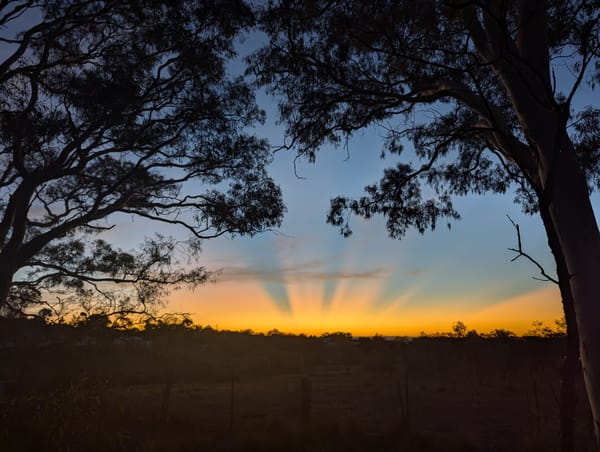
Thank you for meeting me here. This is the place where I share my current practice, as well as the work of others that are lighting me up. The title, “the Crepuscular Hour” comes from a twice-daily phenomenon: the light just before sunset and just after sunrise.
Some peoples’ email browsers aren’t loading all the images, links, and videos in the posts. If that’s you, you can also click through to the web version of this newsletter. Also, a little note that if you read this and have any thoughts, I’d love to hear from you! You are invited to hit reply!
If you prefer to listen, you can hear the audio version of this newsletter on my Soundcloud.
Where you can catch me and my work
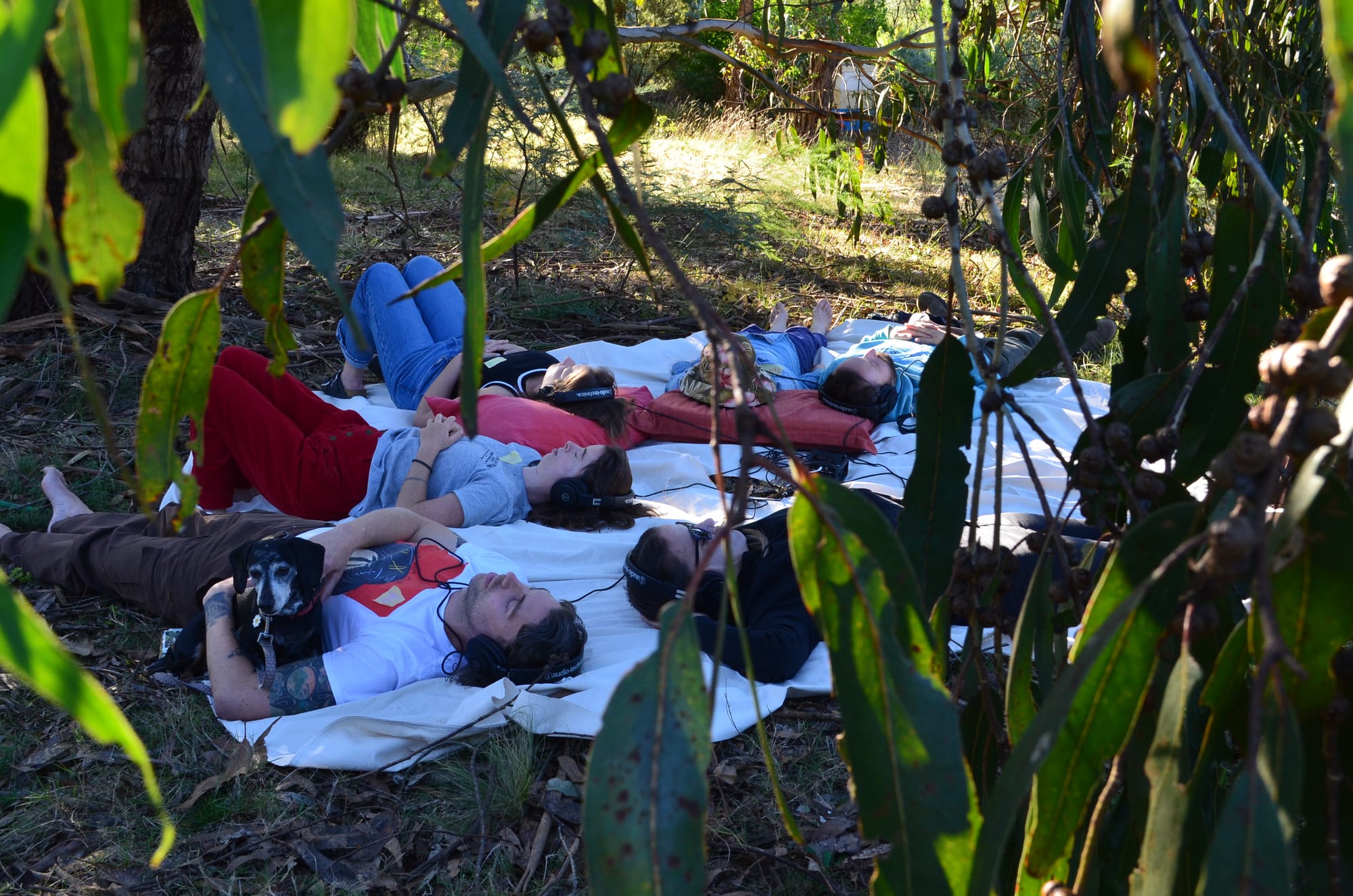
Documentation from my thesis show: soil breathes
I have been slowly updating my Instagram with documentation from my thesis show.
A prescription for communing with earth
Find a plant you feel drawn towards.
Ask the plant if it will help you to listen to the earth. Wait to see if you feel a tug towards or away.
If you feel a tug away, look for a new plant. If you feel a tug towards, approach the plant.
Lie by the plant in a comfortable position.
Place bare skin from at least two appendages into the earth.
Get comfortable: put a blanket on if you need. Put weights on parts of your body that feel tense.
Set a timer for at least eight minutes.
Place at least one hand on the plant.
Breathe in deeply, breathe out very slowly.
Focus on the scents of the earth. Without moving, see if the earth on the left side of your face smells the same as the earth on the right side of your face.
Imagine giving all your weight to the earth.
Unfocus or close your eyes.
Loosen your tongue.
Know that any thoughts or sensations that arise are a collaboration between you, the plant, and the earth.
Draw or write down what arises.
What Country is doing now
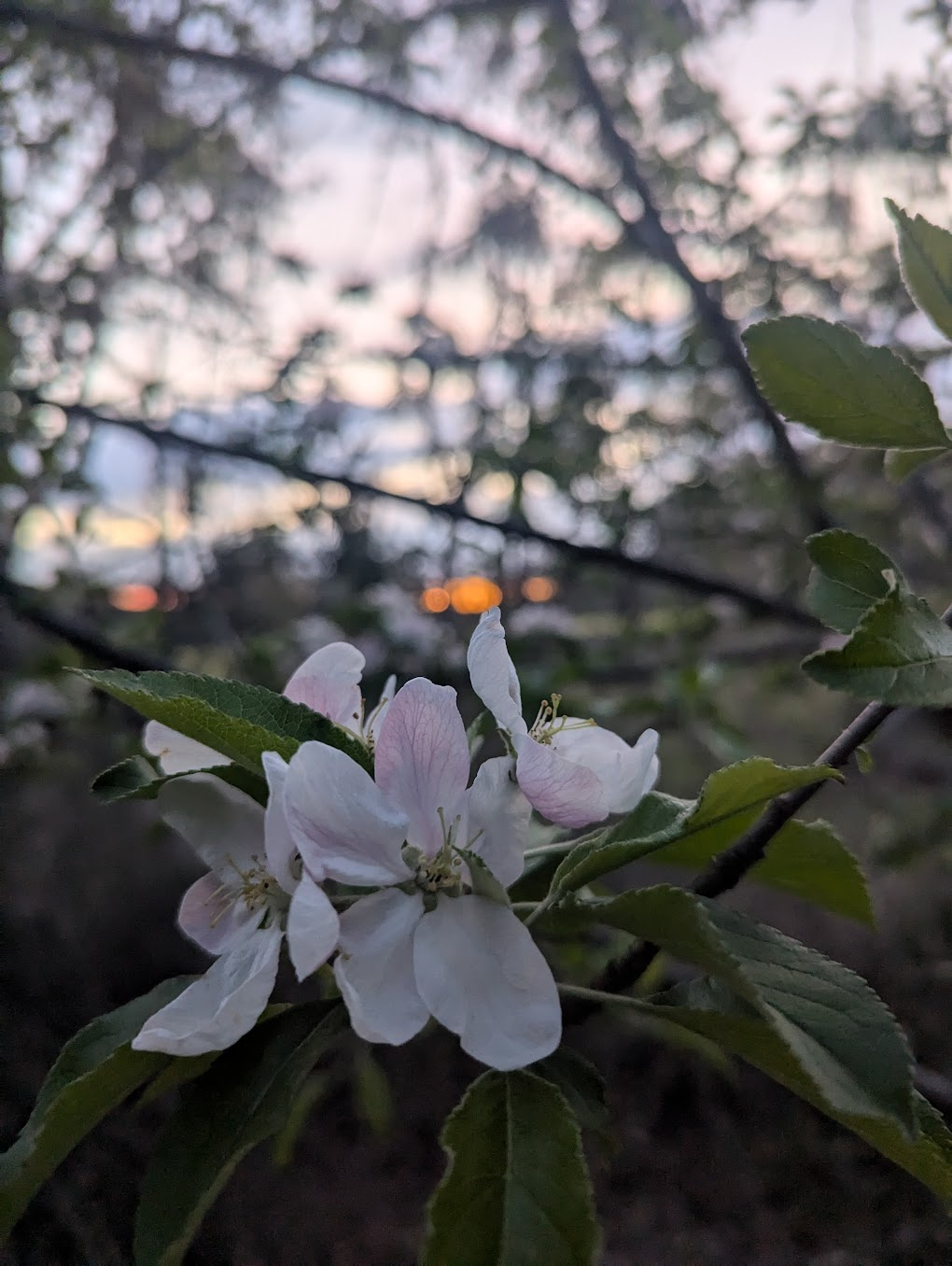
October is my favourite month on Ngunnawal Country. Two wonderful things happen at the same time: wild inflorescences, and lizards.
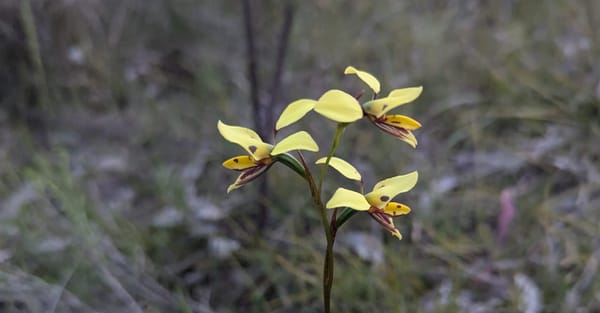
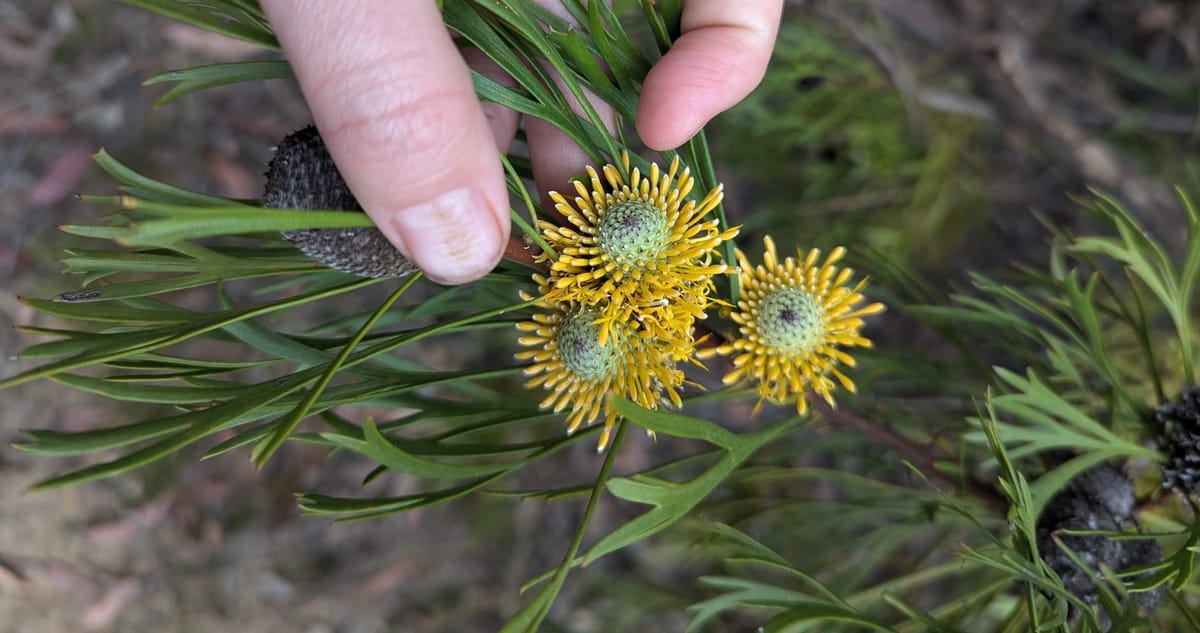
Everything is flowering. In October especially we feel like we live in a feral flower farm. I ache with joy walking outside: the beautiful menthol stink of the prostanthera flowers; the near-narcotic rush of hardenbergia’s exuberant purple; the pretty little paper daisies; the sweet little donkey orchids; the feral apples. We live in an orchestra of colour and scent.
And the lizards! I am perfectly happy to spend hours watching shinglebacks and their slow trundling. I think perhaps my daemon might be a big, fat lizard.
Here is a poem I wrote about shinglebacks and other omens while I was finishing my PhD submission this past February:
The thesis is due imminently,
I descend into a time of deep stillness and velocity.
I retreat further from the world
but the world does not retreat from me:
omens arrive daily, I don’t understand them.
It starts with a big black snake as fat as my forearm, dead by the roadside.
Then, one morning I am making one of my few excursions out of the burrow, driving toward god.
Right there in the middle of the driveway, a bearded dragon has taken direct action against my visit to the Quaker meeting, budging not an inch, even as I drive my car right up until the front wheel kisses his tail.
I do not ask him why he objects to my worship.
Just as I do not ask the tawny frogmouth what she means when she waits for me on my hills hoist at dusk, startling me with her proximity and beauty.
The sweetest harbinger is the shingleback,
as I trundle out to the orangerie,
so too does he,
both of us on thick, stubby legs bulging with muscle.
I love these shinglebacks: the symmetry of their clubbed heads and tails.
Their bluntness in body and temperament.
As I water lemons, he eats daisies whole.
What I’m wild harvesting now
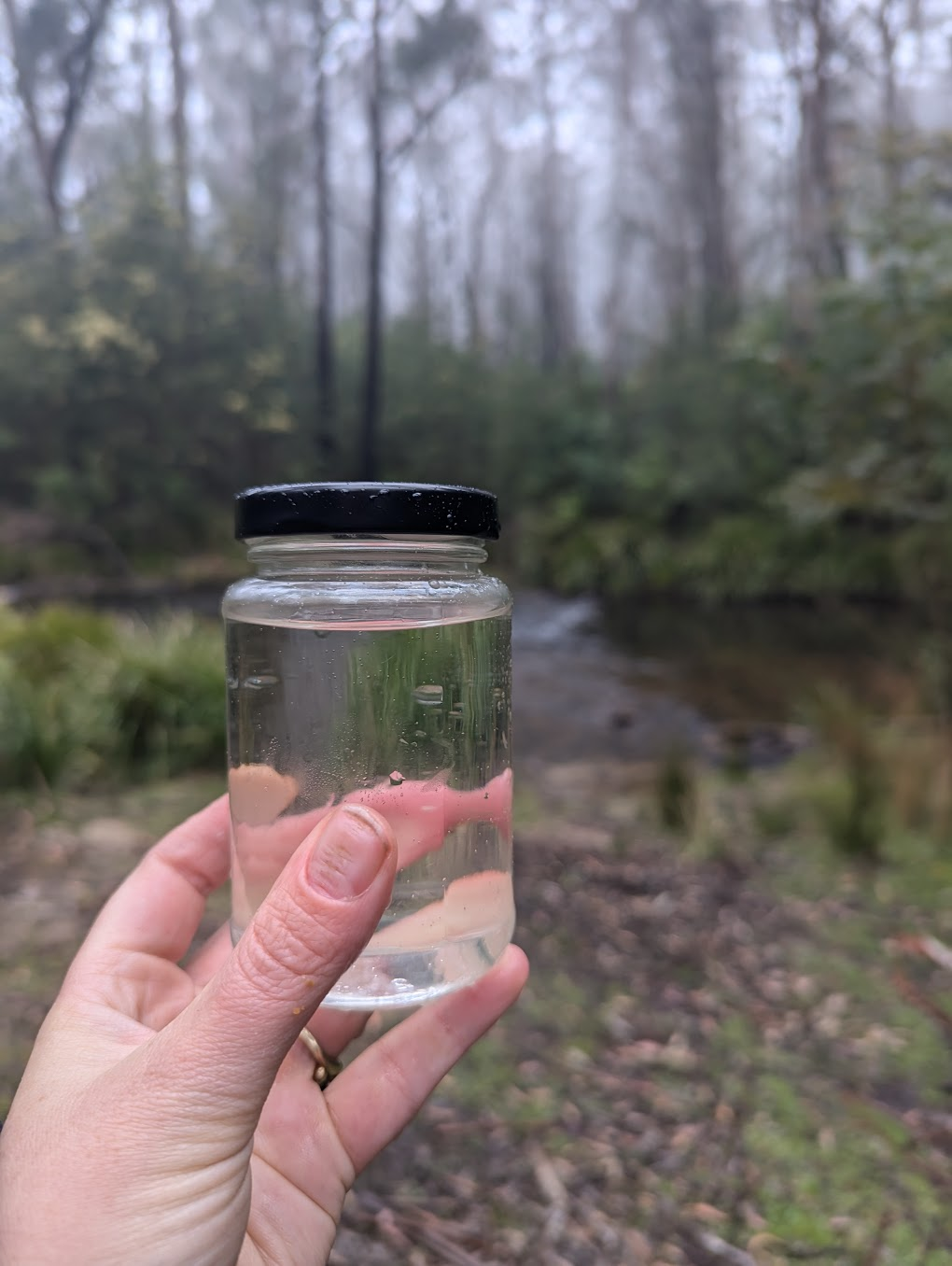
Water. For (perfectly safe) reasons that will be described in the next newsletter, I am unbearably thirsty right now. I wake up every morning near existentially parched. I feel like Tiddalik. I drink like a fish all day. I dream of water. I dream of rainforests. Of selva: the Amazonian humus that is thick with damp. I dream of peat, bogs, and fens. When I daydream, I imagine growing amphibian skin, slipping into a forest creek, drinking with every cell of my skin.
I have been harvesting water. I have been driving to fresh flowing creeks, and walking inside them for as long as I can. Scooping up little jars of water to take to the microscope.
Always Was, Always Will Be (Aboriginal Land)
If you are interested in the medicinal properties of flowers and other plants in the Australian Capital Territory and Southern Highlands, I highly recommend taking a workshop or tour with Wiradjuri man Adam Shipp.
Your Christmas Book List

Welcome to the inside of my mind. It’s mostly books. I don’t really watch tv. I also sometimes don’t sleep. So, I read a lot of books. Some of them are really good. Some of them are nowhere as famous as they should be. I’m here to change that.
Buy Shaman for: your uncle with a special interest in Otzi the ice man, your anarcho-primitivist girlfriend who’s always trying to convince you to learn to tan hides, your archaeology-trained office mate.
Shaman pairs well with: Conrad Spindler’s the Man in the Ice, Werner Herzog's Cave of Forgotten Dreams, fantasising about your strategy for winning “Alone”, getting high on wild-foraged artemisia.
There are two books I regularly reach for when I need comfort, or when I need to be reminded of the emotional breadth of human experience. These books are Autobiography of Red by Anne Carson, and Shaman by Kim Stanley Robinson.
The plot of Shaman is fairly simple: it is a bildungsroman about a young shaman apprentice, following the arc that begins with his initiation and ends with him stepping into the role of his deceased master. On the way he falls in love, starts a family, and undertakes a harrowing and nearly-deadly rescue of his wife. As Stanley Robinson has pointed out, traditional plots serve a purpose: they are familiar, and this allows a writer to go deeply into the detail surrounding them. The deceptively simple plot of Shaman allows for rich world-building and characterisation. Almost every aspect of palaeolithic camp life is rendered in vibrant detail, from Heather the herb woman’s robust insults-”bunch of drunken old spelunkers, you shamans, and you hunters mere pig-stickers and jerk-offs”; to the hunger months in late spring; to the ceremonies and poetry to usher in the seasons.
The book touches on other fascinating aspects of our deep past: the painting of caves; the collaborations and frissions with our Neanderthal cousins; the big multi-tribe summer festivals (complete with proto-fireworks and proto-alcohol); pre-compass navigational methods; a Europe shared with megafauna; a melanised world, where most Europeans were black and brown.
I love this book because it reminds me of what it actually means to be a person, without all the habits of culture, and without the shaping and blackmail of capitalism. As Robinson regularly reminds us in interviews, these people were genetically exactly the same as us (minus the lactose tolerance). Shaman strips us down to our core as a species. And what I see in it is remarkably similar to what I see in myself: a longing to understand the world; a feral and dogged curiousity; the drive to make extraneous beautiful things and to tell compelling stories; the absolute need we humans humans have be together; the deadliness of the unchecked ego; the intensity of romantic love; the desire for sex; the joy of moving a body; the deep and spiritual love of wild places.
The world was so great, so beautiful. Something like a lion: it would kill you if it could, but in the meantime it was so very, very beautiful. He would have cried at how beautiful it was, but he was laughing too much, he was too happy at being there walking in it.
Other Good Things

Ina Indira Shanahan
A very good thing is the life and art of my old friend Ina Indira Shanahan, who died on September 30 2025 at the age of 68. The first time that Indira and I met, we were seated next to each other at a vegan buffet in Montreal, with other members of the SenseLab. I told her that I loved her outfit, and she told me that the amazing denim jacket which pulled it all together was from Kmart. I replied that my favourite jeans were from Kmart, we were fast friends. Indira was a deeply brave and resourceful person: she migrated from Germany to Australia in her early 20s on a hunch, and made it work as a sought after costume designer and milliner for prestigious venues including the Victorian Opera Company. She was one of the first to introduce hakomi therapy to Australia. She was a rare and precious person who lived most of her life in the underground river of mysticism and intuition, and yet also deeply understood critical theory. This was part of why I loved her so much: the special people who understand the tug of following a spiritual longing, but also require precision and clarity, are my heart's home.
In many ways, Indira was the incarnation of the divine feminine of my understanding: completely impatient with patriarchy and patriarchal behaviour, yet deeply forgiving; a fashion icon; a connoisseur of rest and its importance (in a deep way only known to those living with chronic fatigue); whip-smart; intensely and quietly psychic; a wellspring of creativity.
All deaths are tragic. The death of an artist is a special flavour of tragedy: Indira has stopped making. I watched Indira write a thesis for ten years, and I am devastated that her brilliance and insight didn't quite make it into the world. Over the next few months, I will be trying to surface and share the legacy of my deeply lucid friend. Watch this space.
Mutual Aid
Victoria's Asylum Seeker Resource Centre does wonderful work advocating for refugees, and helping them to integrate into Australian Society. There are lots of ways to support them. These include giving financially, donating food, and volunteering your time.
If you have a mutual aid request that you would like me to post in the November Newsletter, please get in touch. Nothing is too silly or small. Need a microwave? Let me know. Need people to buy your art so you can get surgery? Let me know. Need a sublet for January? Let me know.
Thank you,
If you feel moved by anything in the newsletter, and want to forward it to a friend, that would be so helpful to me.
Love and solidarity,
Flo Sophia Dacy-Cole